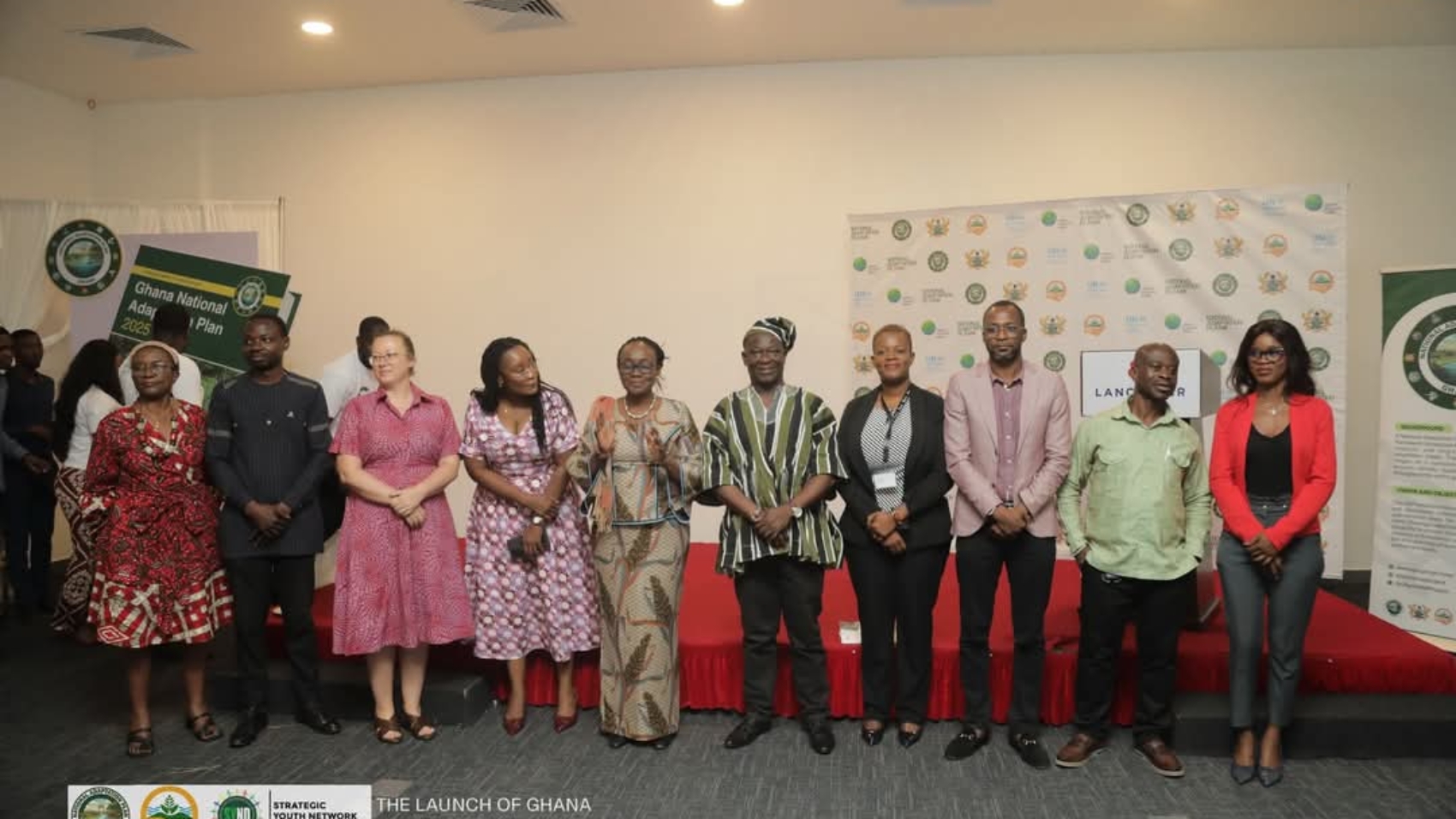
Accra, Ghana – 4 December 2025: HATOF Foundation joined national leaders, development partners, and stakeholders at the official launch of Ghana’s National Adaptation Plan (NAP) held at the Lancaster Hotel in Accra. The launch marks a major milestone in the country’s climate resilience efforts, providing a long-term framework to guide adaptation priorities across sectors, communities, ecosystems, infrastructure, and livelihoods.
Representing the Foundation, Deputy CEO Ms. MaryJane Enchill delivered a statement emphasizing the vital contribution of civil society organizations (CSOs) in driving inclusive, community-led climate adaptation in Ghana.
In her remarks, Ms. Enchill emphasized that CSOs remain closest to community realities and therefore play a crucial role in ensuring that national adaptation strategies reflect the lived experiences of communities.
“Civil society is uniquely positioned to bring forward real, first-hand information about local vulnerabilities, needs, and opportunities. Our role is to ensure that national plans are grounded in community realities, not just broad assumptions,” she noted.
She outlined several initiatives through which HATOF has strengthened the participation, capacity, and impact of civil society in Ghana’s climate response. These include:
- A GEF-SGP–funded Capacity Development and Knowledge Management Project, which enhanced CSO capacity to engage effectively in national and sub-national planning and policy processes.
- The GCF CSO Readiness Project, through which HATOF trained 40 CSOs across 10 networks on climate policy, project design, monitoring, evaluation, and financing, boosting civil society’s ability to contribute to Ghana’s Nationally Determined Contributions (NDCs) and wider adaptation priorities.
- Community-based biodiversity restoration and nature-based solutions initiatives that support both climate resilience and local livelihoods.
According to Ms. Enchill, these experiences demonstrate a proven model in which empowered and knowledgeable CSOs help deliver more grounded and meaningful climate adaptation outcomes.
As Ghana begins implementing the NAP, HATOF reaffirmed the shared responsibility of civil society in achieving national adaptation goals. Ms. Enchill outlined three core commitments CSOs bring to the process:
- Amplifying community voices to ensure local realities shape adaptation interventions.
- Supporting implementation through on-the-ground restoration, livelihood, and climate-resilience projects.
- Facilitating access to climate finance by helping develop proposals, mobilize resources, and promote transparency in implementation.
Ms. Enchill reiterated that successful adaptation requires strong, coordinated partnerships between government, communities, and civil society.
“Achieving a climate-resilient Ghana requires more than top-down planning. It demands collaboration, inclusion, and the full engagement of communities. HATOF is ready and committed to playing this role today and in the years ahead,” Ms. Enchill concluded.
She pledges HATOF’s commitment to collaborating with partners at all levels to support the implementation of the National Adaptation Plan and promote a more resilient, inclusive, and sustainable future for Ghana.
