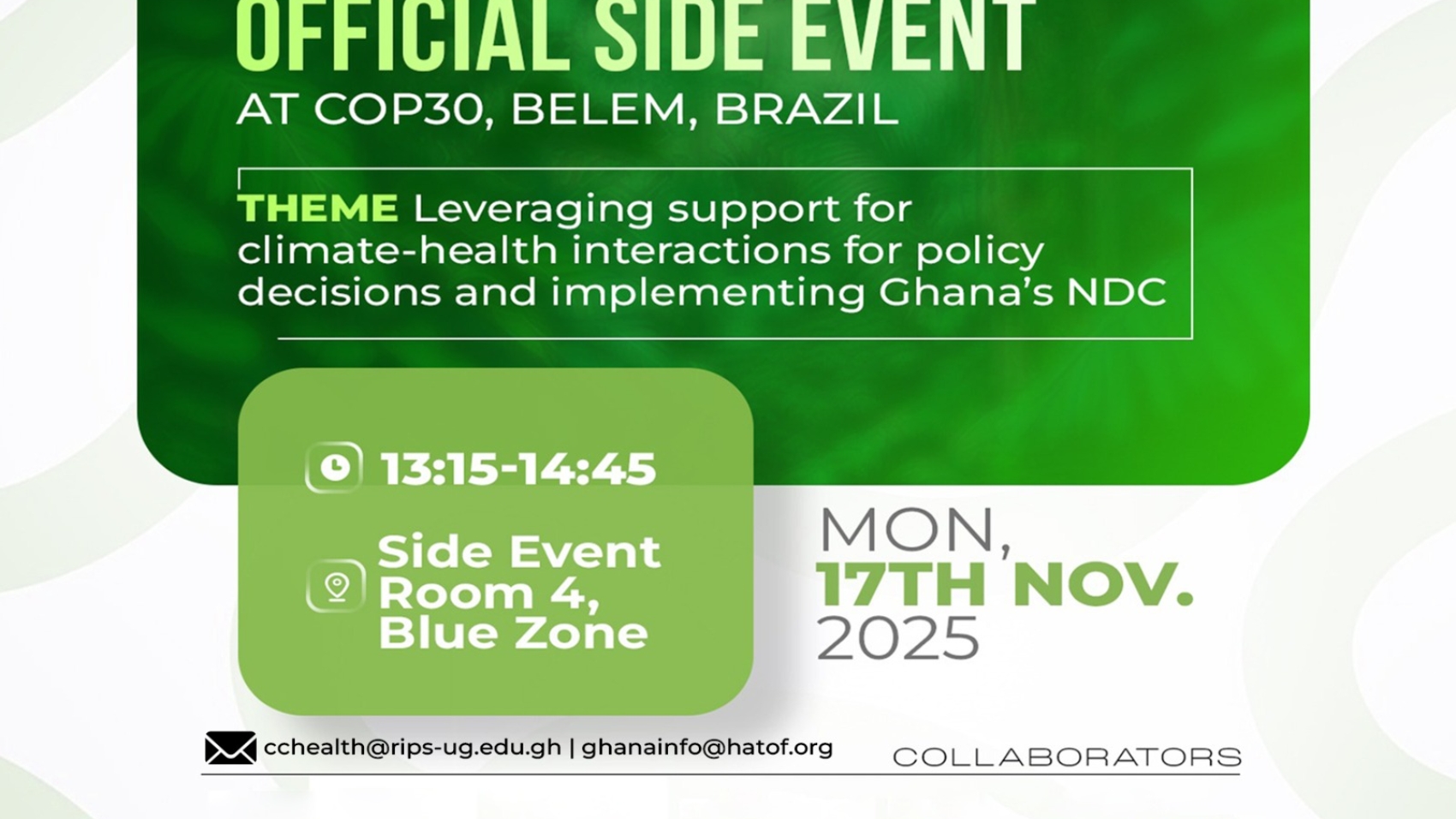
Title 1. Leveraging support for climate-health interactions for policy decision-making and
the implementation of Ghana’s NDCs
Lead Organizer HATOF Foundation
Collaborating Institutions: SOSCHI-Ghana (Regional Institute for Population Studies), Environmental Protection Authority (EPA), Forestry Commission, Ghana Statistical Service (GSS), and United Nations Global Platform.
Introduction Climate change presents urgent and complex challenges for health, ecosystems, and sustainable development, particularly in the Global South, where vulnerabilities are high, and data systems remain fragmented. Despite growing evidence linking climate impacts to health outcomes and environmental degradation, from heat-related mortality to deforestation and biodiversity loss, many national data and policy frameworks still lack the capacity to systematically integrate these insights for informed decision-making.
This side event will showcase Ghana’s leadership in developing integrated, data-driven approaches to climate action that link health, environment, and sustainable livelihoods. It will highlight innovations in climate–health data systems and the role of nature-based solutions, and forest carbon initiatives in accelerating the implementation of Ghana’s NDCs and strengthening resilience across sectors. This event aligns with COP30’s theme, “Climate and Biodiversity for a Just Transition.”
Key Discussion Areas
➢ Integrating Climate–Health Data into National Policy: Demonstrating how Ghana is piloting UN endorsed frameworks to mainstream climate–health interactions into its NDCs, NAPs, LTS, and TNAs.
➢ Demonstrate the application of novel metrics and statistical methods, including data integration and local vulnerability modelling, developed through Ghana’s implementation.
➢ Health, Ecosystem, and Finance Synergies: Connecting ecosystem protection and forest management to improved public health outcomes, biodiversity conservation, and climate justice.
➢ Civil Society and Data Innovation: Highlighting HATOF Foundation’s work in translating data into community-based adaptation, preparedness, and advocacy.
➢ Inclusive Implementation and Financing: Exploring how health, environment, and forestry sectors can jointly mobilize resources, private sector investment, and local participation to accelerate the delivery of Ghana’s NDCs and the Global Stocktake (GST).
Objective
This session aims to catalyse an inclusive dialogue on integrating climate, health, and ecosystem resilience into national policy and planning. By linking innovations in climate–health data with lessons from REDD+ initiatives, the discussion will explore how multisectoral partnerships can strengthen Ghana’s adaptive capacity, support biodiversity conservation, and ensure equitable, evidence-based implementation of the NDCs
Expected Outcomes
➢ Enhanced understanding of how climate–health data and REDD+ benefit sharing can jointly advance integrated NDC implementation.
➢ Greater recognition of data-driven approaches as complementary tools for resilience and public health protection.
➢ Identification of joint financing, data-sharing, and policy entry points to sustain Ghana’s integrated climate–health–forestry initiatives.
➢ Increased visibility of Ghana’s leadership in developing high-integrity, datadriven, and socially inclusive approaches to climate action.
SPEAKERS
➢ Hon. Issifu Seidu, Minister of State in charge of Climate Change and Sustainability, Ghana
➢ Prof. Nana Browne Klutse, CEO, EPA, Ghana
➢ Prof. Delali Dovie, SOSCHI-Ghana, Regional Institute for Population Studies
➢ Dr. Samuel Dotse, CEO, HATOF Foundation
➢ Dr. Nana Antwi Boasiako Amoah, Director, Climate Vulnerability and Adaptation, EPA, Ghana
➢ Forestry Commission, Ghana
Date Monday 17 November, 2025
Time 13:15-14:45 (Local Time)
