April 15, 2026
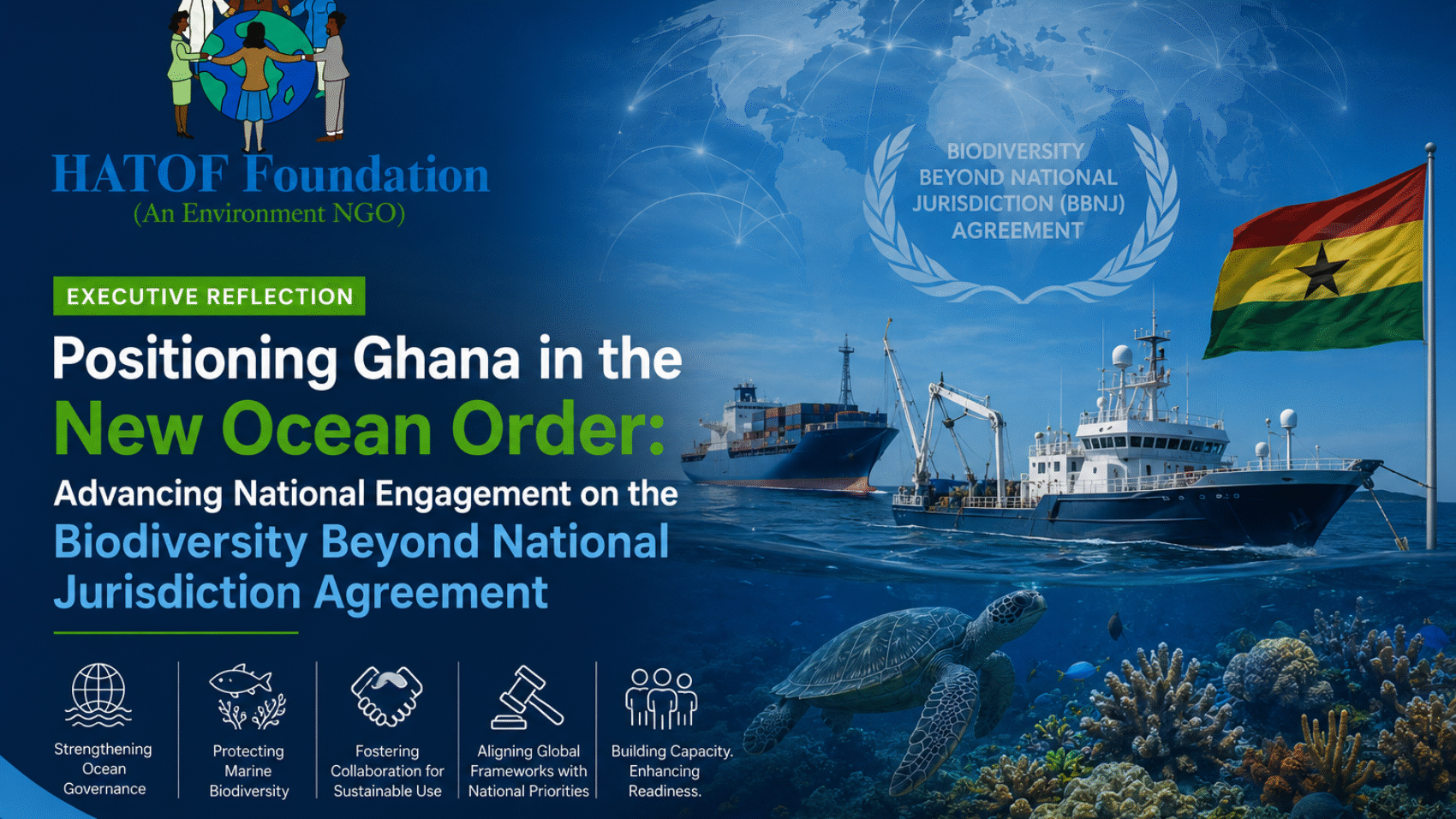
HATOF Foundation, an international environmental Non-Governmental Organization, has taken a deliberate step to advance Ghana’s engagement with the Agreement under the United Nations Convention on the Law of the Sea on the Conservation and Sustainable Use of Marine Biological Diversity of Areas Beyond National Jurisdiction (Biodiversity Beyond National Jurisdiction (BBNJ) Agreement).
Current engagement with the Agreement in Ghana remains limited in both awareness and technical depth. At the same time, its implications for fisheries governance, offshore resource management, and marine research are immediate, creating a gap between relevance and readiness.
By convening a focused national webinar on the Agreement and its implications for Ghana’s Blue Economy, the organization has opened a practical entry point for stakeholders to engage with the Agreement in concrete terms: what it covers, where it intersects with Ghana’s priorities, and what it will require of institutions as we advance. This is not about general advocacy; it is about positioning Ghana to respond with clarity.
HATOF has become a practical platform for ocean policy engagement, connecting global frameworks to national processes and making them accessible and relevant for decision-making. This includes translating technical content into usable knowledge, maintaining continuity in policy discussions, and ensuring that stakeholder engagement moves beyond one-off events.
Ghana’s engagement with the Agreement requires specific institutional actions, including clarifying national mandates across lead agencies, integrating BBNJ priorities into existing ocean and fisheries policies, and strengthening technical capacity in areas such as environmental impact assessments and marine genetic resources. There is also a need to align this process with existing commitments under the Convention on Biological Diversity, while building on current efforts such as the designation and management of a Marine Protected Area. These steps are necessary to ensure that Ghana can participate effectively in negotiations, access emerging opportunities, and implement its obligations under the Agreement.
As such, a coordinated, multi-stakeholder approach is essential to enable government institutions, regulatory agencies, research bodies, the private sector, and civil society to work within a structured framework to ensure readiness and strategic positioning to address the scope and technical demands of the Agreement.
HATOF will continue to lead in this space by convening targeted dialogues for knowledge management and capacity building and contributing to policy processes. The objective is clear: to ensure that Ghana is informed, prepared, and able to engage effectively.
