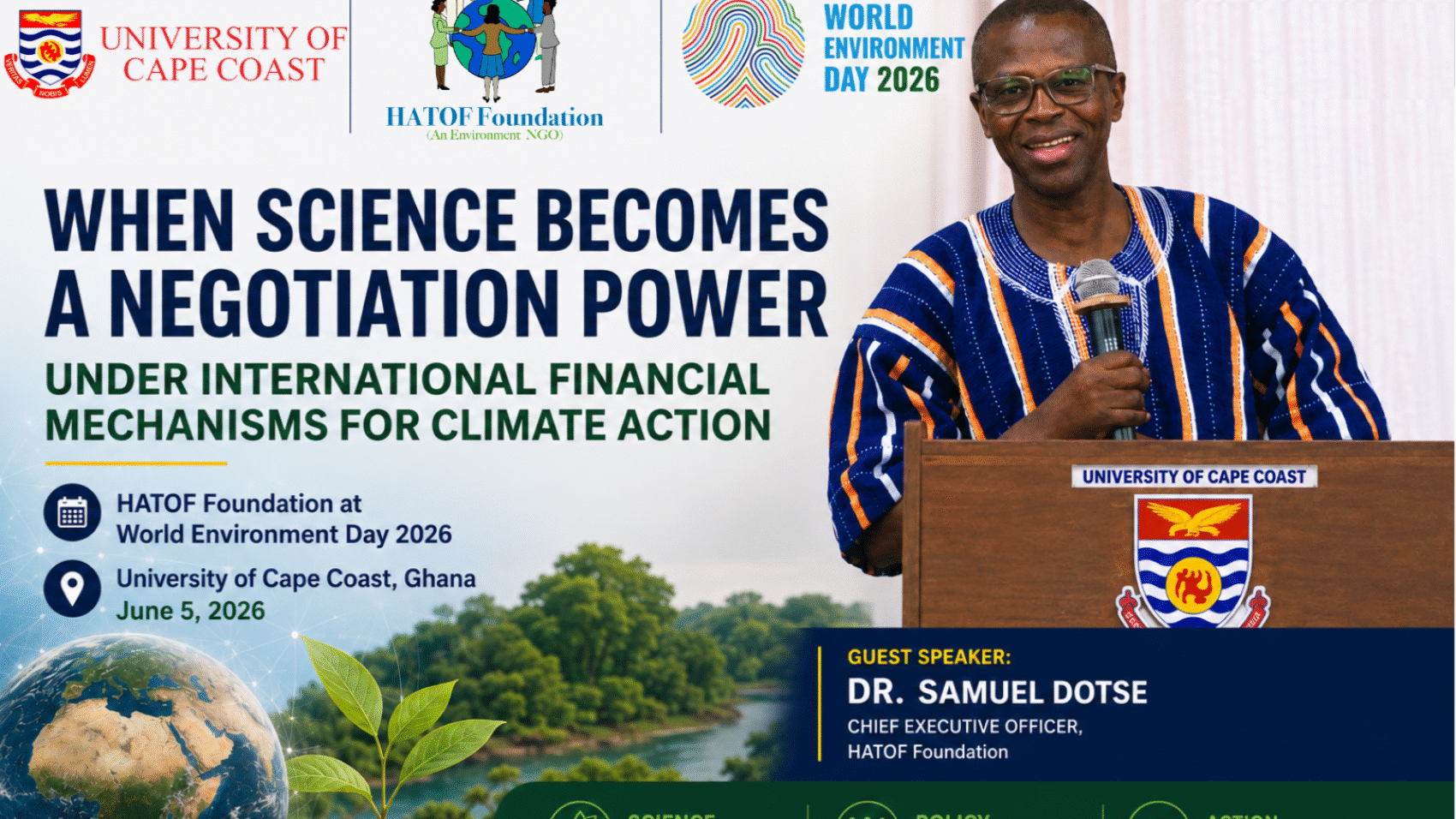
University of Cape Coast, Ghana, June 5, 2026: On the morning of World Environment Day 2026, the Department of Environmental Science at the University of Cape Coast (UCC) gathered students, faculty, and guests under one roof to mark the occasion. The theme this year, “A Global Call to Climate Action,” set the tone for a day of honest conversation about where Ghana stands in the global climate story.
Dr. Samuel Dotse, the Chief Executive Officer of HATOF Foundation, was invited to serve as the Guest Speaker for the symposium. He spoke on the topic: “When Science Becomes a Negotiation Power Under International Financial Mechanisms for Climate Action.”
Dr. Dotse argued that the ability to attract international climate finance from mechanisms such as the Green Climate Fund, the Global Environment Facility, and loss and damage funds does not rest solely on vulnerability, but also on data. Countries with updated inventories, ecosystem valuations, and strong biodiversity datasets walk into negotiations with leverage, while those without them, however climate-exposed, risk being sidelined.
Ghana, he argued, finds itself in a difficult position: although ecologically rich, home to portions of the Upper Guinea Forest, biodiversity-significant wetlands, and a highly vulnerable coastline, it is underrepresented in the datasets that international allocation systems use. That gap, Dr. Dotse said, is becoming costly. A significant part of his address emphasized the inseparability of biodiversity from climate action. He posed three pointed questions: How can farmers build resilience as pollinators decline? How do communities pursue mitigation as forests shrink? How do coastal communities withstand storms as mangroves disappear? These questions anchored the argument that biodiversity data is now required, not a supplement, in climate proposals.
His call to universities was direct: institutions like UCC cannot afford to stay in their traditional academic lanes. They need to become environmental intelligence hubs, generating long-term ecological data, conducting biodiversity mapping, and producing the kind of science that feeds directly into negotiations and project proposals. As he put it, “biodiversity is no longer just for conservation reports. It is the climate negotiation capital.”
Attendees at the symposium included faculty members, the Provost of the College of Agriculture and Natural Sciences, the Dean-Elect of the School of Biological Sciences, and students from across departments, including Environmental Science, Civil Engineering, Oil & Gas, and Coastal Management. An inter-hall debate, drawing participation from nine (9) UCC halls, gave students a live platform to wrestle with these ideas.
For the HATOF Foundation, the day highlighted the importance of our work, linking science with policy and ensuring policies have the resources needed for action.
Happy World Environment Day.
