
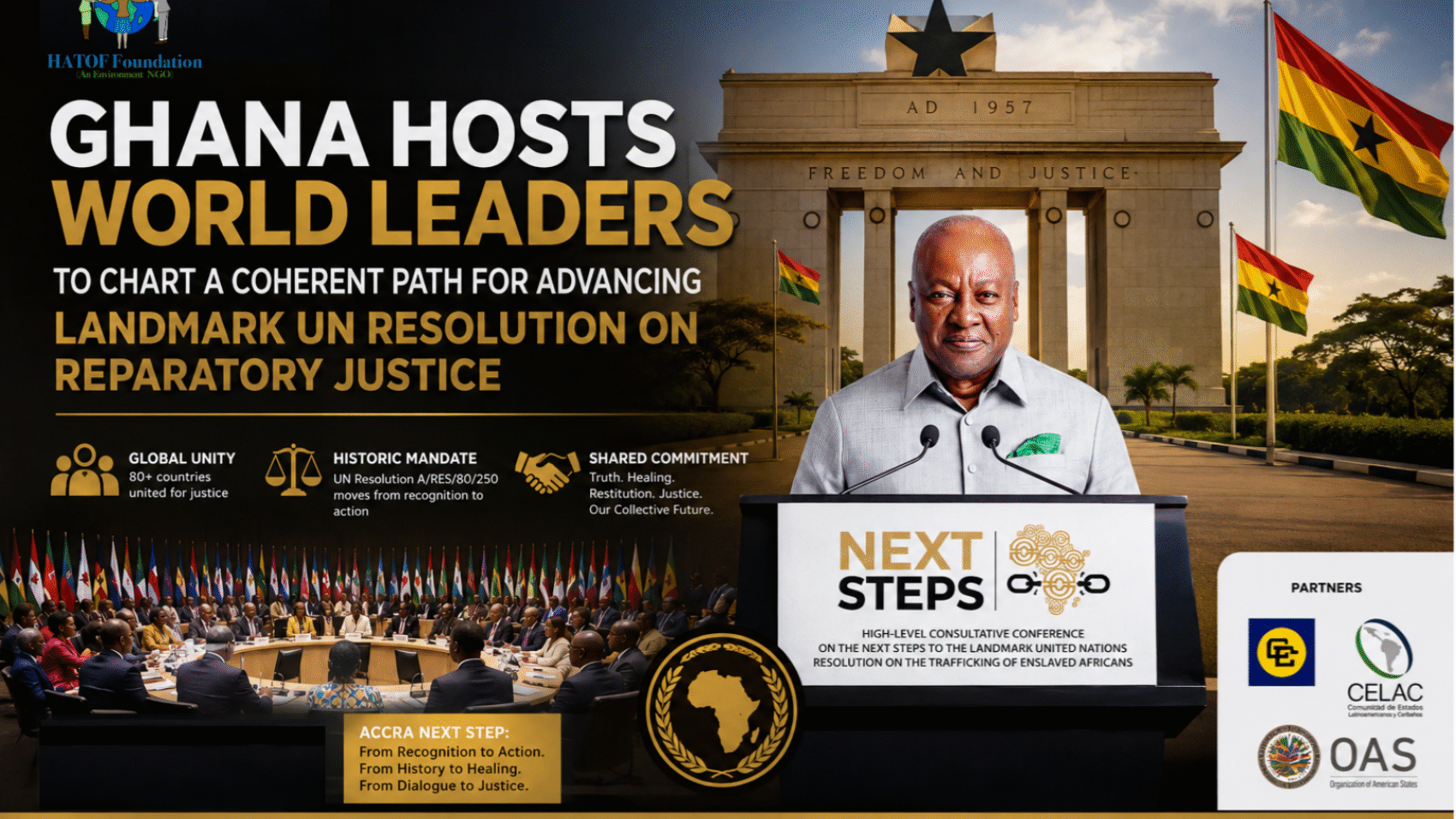
Accra, Ghana – June 19, 2026 — World leaders, policymakers, representatives of the African diaspora, academics, civil society organizations, and activists from over 80 countries convened in Accra for a three-day High-Level Consultative Conference to deliberate on the next steps following the adoption of the landmark United Nations General Assembly Resolution A/RES/80/250, which declared the trafficking of enslaved Africans and the racialized chattel enslavement of Africans as among the gravest crimes against humanity.
Held from June 17–19, 2026, at the Kempinski Hotel in Accra, the conference marked the first major global gathering since the adoption of the historic resolution by the United Nations General Assembly on March 25, 2025, in New York. Participants reflected on the significance of the resolution, assessed progress since its adoption, and explored practical mechanisms to translate its principles into concrete action.
The conference brought together several Heads of State and Government, including President of Namibia, H.E. Dr. Netumbo Nandi-Ndaitwah; President of Liberia, H.E. Joseph Nyuma Boakai, Sr.; President of Senegal, H.E. Bassirou Diomaye Diakhar Faye; Prime Minister of Barbados, Mia Amor Mottley; while President of the French Republic, H.E. Emmanuel Macron, participated virtually. Also in attendance were Ministers of Foreign Affairs, senior government officials, representatives of regional organizations, people of African descent, civil society organizations, academic institutions, and non-governmental organizations.
Delivering the keynote address, President of Ghana, H.E. John Dramani Mahama, called for a renewed global commitment to reparatory justice, emphasizing the need to demand reparations for the enslavement of “our people and the colonization of our land that resulted in the theft of natural resources.”
He stressed that reparatory justice is “not only about acknowledging the past but also about expanding opportunities, advancing human development, and creating a more just future for communities affected by the enduring consequences of this historical injustice.”
President Mahama further urged constructive engagement in the global reparations discourse, noting that “though none of the present generation can be held personally responsible for the transatlantic slave trade and the racialized chattels of enslaved Africans, every generation inherits responsibilities from the past.” While current generations may not bear direct responsibility for actions committed centuries ago, he argued, “we are responsible for the wealth those actions have helped to create – both achievements and failures.” Consequently, he stated, “we must be prepared to engage constructively even with the descendants of those who enslaved our forefathers and foremothers.”
President Mahama also underscored the importance of a gender-responsive approach to reparatory justice. He observed that the experiences of enslaved women and girls have often been marginalized in historical narratives.
“History remembers the names of the ships and merchants trading companies but forgets the names of the women whose bodies became the site of exploration or the mother standing on the shore, uncertain she will see her child again,” he said. “For many enslaved women, exploitation did not just end with the body; their bodies became instruments of economic extraction, and their capacity to bear children was transformed into a means of reproducing bondage across generations.”
According to President Mahama, reparatory justice must ensure that “the historical experiences of women and girls cannot remain footnotes in the global narrative but must occupy their rightful place at the center of truth-telling, remembrance, and memorialization.”
Renowned playwright and Nobel Laureate Wole Soyinka described the resolution as “a golden opportunity” to re-examine “a divisive history” and the continuing impact of slavery on relations between former colonizing nations and those that suffered under slavery and colonialism.
Soyinka warned that “the slave trade is not over,” pointing to contemporary forms of slavery and human trafficking affecting children and young people. He described modern slave markets and trafficking networks as “the common refuse of perpetual iniquity” and argued that opposition to reparatory justice reflects a “retrogressive understanding of history and of human relationships.”
He further noted that Africa’s challenges are not solely external, observing that some leaders continue to treat citizens “as just slaves.” For Soyinka, the broader objective must be the “rehumanization” of memory and the collective restoration of people traumatized by slavery and historical injustice.
President of Namibia, H.E. Dr. Netumbo Nandi-Ndaitwah, reaffirmed her country’s commitment to the continental quest for justice, stating that Namibia stands ready “to join others and work together in this journey.”
Describing the adoption of Resolution A/RES/80/250 as “an important historical landmark,” she emphasized that “it is not a destination. It is the beginning of a journey towards truth, acknowledgment, healing, and justice.”
She noted that the consequences of slavery, colonialism, and historical injustice continue to manifest through inequality, poverty, lost opportunities, and perceptions of people’s place in society, underscoring the continuing relevance of the reparatory justice agenda.
Prime Minister of Barbados, Mia Amor Mottley, echoed calls for a unified global effort, stressing that the demand for reparations is “not one of aggression” or violence but “one of necessity for healing humanity.”
She argued that the categorization of Africans as “chattel” and “property” stripped millions of people of their dignity and freedom and that meaningful repair remains necessary to address the shame, injustice, and structural inequalities that continue to persist through systems of power.
“Reparations should be pursued not as an act of charity but as an act of justice,” she stated.
The conference concluded with the adoption of the Accra Next Step, a framework intended to guide future international cooperation and action on reparatory justice.
Among its key outcomes was the establishment of a three-panel advisory architecture comprising:
- A Global Advisory Panel on Reparatory Justice to provide strategic guidance and advance international dialogue and cooperation on reparatory justice.
- An Expert Panel on the Restitution of Cultural Artifacts to facilitate efforts aimed at returning cultural property and archives to their rightful communities; and
- A Legal Panel for Reparatory Justice to explore legal pathways, deepen legal understanding, and develop approaches consistent with the rule of law and human justice.
The adoption of the Accra Next Step signals a collective commitment by participating states, institutions, and stakeholders to move beyond recognition to practical measures to advance truth, healing, restitution, and justice for people of African descent worldwide.
